Saturday, August 23, 2008

Breeding Betta Fish Successfully


Breeding Betta Fish Successfully Getting That Prized Full Moon Tailed Betta Doesn't Happen OverBreeding Betta Fish Successfully Getting That Prized Full Moon Tailed Betta Doesn't Happen Overnight

By Troy Nantais

Breeding betta fish is something that many people have tried and even more have struggled with. However, learning to breed betas successfully does require that some work. It isn't like breeding guppies at all where you just simply put a few fish in a tank and start making babies. No breeding betta fish successfully requires proper knowledge of betta fish care, and in learning to apply tips that are crucial in order to get that next prizes full moon tailed betta. Here are a 3 quick tips that will help you on your next attempt at breeding betta fish

1.Don't use Store Bought Bettas. I know that this may sound weird because chances are the betta you have was bought at your local tropical fish store but there is a reason behind this tip. For one store bought betta fish are usually the wrong kind of fish. Most of the really beautiful bettas come from qualified breeders and the store bought ones in all likely hood are the wrong kind. The other reason is, store bought fish generally are not in the mood for breeding if you know what I mean. Store bought betas are usually older, less hearty and just not as inclined to have love affairs. So the solution when breeding betta fish buy them from a qualified betta breeder, it might cost you more, but you have a far greater chance of success.

2. Always Buy Breeding Betta Stock in Pairs. This is really an extension of point number one. Once you realize you need to stop using store bought fish in trying to breed betas don't chance out by buying only one. That kind of is self defeating of point number one.

3. Buy More then One Pair. This is the real secret to breeding betta fish. Betta fish are like people when it comes to love. Don't think that just because you thrust two betta fish on a blind date that your going to make the magic happen. It many cases your going to find perhaps the male just doesn't like the female you chose, or the male is interested but she is not in the mood. By buying more then one air of breeding stock you double your chances of making a love connection.

T Nantais has been an avid tropical fish hobbyist and started breeding betta fish when he was a kid. For more information about betta fish care and more tips on breeding betta fish successfully visit his site at http://www.squidoo.com/betta-fish-breeding

Article Source: http://EzineArticles.com/?expert=Troy_Nantais
http://EzineArticles.com/?Breeding-Betta-Fish-Successfully-Getting-That-Prized-Full-Moon-Tailed-Betta-Doesnt-Happen-Overnight&id=1189148


Friday, July 25, 2008

Betta Breeding

Bettas are bubble-nest breeders and are frequently bred in aquarium. If you wish to try breeding Betta you will have to start by obtaining a pair. The best method is usually to get at least two female Betta and two males. It is important that you select healthy looking fish with good external features. By preparing at least four Bettas and getting them into breeding condition you will have replacements if a couple turns out to be incompatible, or if any Betta turn our to be unhealthy or incapable of breeding. To get your Bettas into breeding condition should keep them in a suitable environment and follow all the general guidelines for keeping Bettas, such as ideal water temperatures, suitable pH levels etcetera. Feed the potential parents live or frozen meaty foods twice a day or more.

Start off by keeping all four individual Bettas isolated, but still able of noticing each other during 3-4 days. You can also use another method where you isolate the fish completely from other Bettas during four days. Somehow isolation seems to trigger spawning in Bettas, but we still do not know why.

A 2.5-10 gallon aquarium is large enough to function as a breeding aquarium for Bettas, as long as the water can be 5 inches deep. Decorate the aquarium with floating aquatic plants, and also insert a few clay pots as hiding places. The water temperature should be kept constant between 80 and 82 degrees F. A cover is usually necessary to keep the water and air at a constant temperature, and if the room is subjected to draft a cover is absolutely necessary since any draft can cause water movements that will disturb the Gourami bubble-nest.

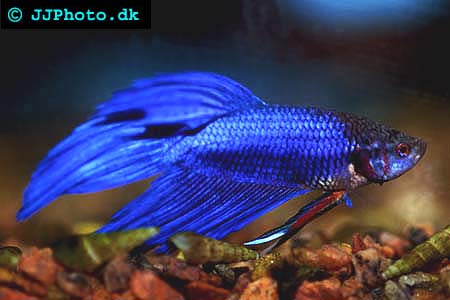
male betta picture
A blue male Betta. Copyright www.jjphoto.dk
Most Betta breeders choose to add the male Betta to the breeding aquarium a few hours before the female Betta is introduced. This way, the male will get some time to explore the breeding aquarium and establish his territory. When you have placed the female Betta in the breeding aquarium you will usually have to wait no more than a few hours before you can watch the male Betta build a beautiful bubble-nest. The female Betta will display dark vertical bars on her body, and this is a sign that shows that she is ready to spawn. Even if the Betta pair is highly compatible and ready to spawn, they will fight each other in the breeding aquarium. The two will even try to tear up each others fins, and this might look scary but actually makes sense from an evolutionary perspective. By fighting each other, both sexes prove that they are strong individuals that will pass on good DNA to the new generation. A Betta does not want to waste time and energy by breeding with an unhealthy fish with genetic defects.

If your Betta pair still haven’t spawn within tree days after the female Betta was placed in the breeding aquarium, the pair is not compatible and will not breed. Take away the female Betta and insert your other female Betta to the breeding aquarium. If the male Betta never got started on his bubble-nest building, it is probably something wrong with him and you should remove him from the breeding aquarium instead and insert the other male. You can also remove both fishes and give the other pair a try.


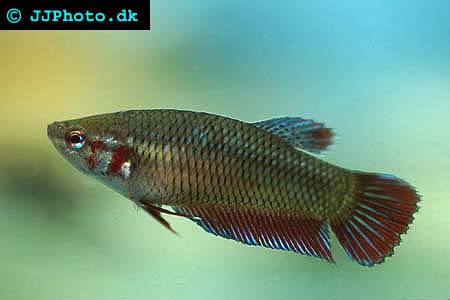
female betta picture
A female Betta. Copyright www.jjphoto.dk
Hopefully, one of the possible combinations will prove successful, and eggs will be deposited, fertilized and placed in the bubble-nest. As soon as this has happened, you should remove the female Betta from the breeding aquarium. She will most likely be suffering from wounds from the courting period, and should therefore be placed in a medicated container. The male should be left to care for the offspring, and not be removed until the fry is free swimming. It is a good idea to place him in a medicated container as well. Newly hatched Betta fry will get enough nutrition from their yolk sacs and should not be fed during the first day. When the yolk sacs have been consumed, instinct will draw the fry towards moving objects in the aquarium. In the wild, Betta fry eat micro organism and your Betta fry should therefore ideally be fed vinegar eels or similar. Vinegar eels are microscopic nematodes and small enough for young Betta fry to consume. When the Betta fry are a few days old, you can start feeding them newly hatched brine shrimp. Small daphnia, grindle worms and other types of micro-worms are also suitable.

Betta Anatomy

The Betta genus is a part of the Gourami family (Osphronemidae). Earlier, the Betta genus was considered a part of the Anabantidae family. The reason behind this is the fact that all Betta species have labyrinth organs, just like the Anabantidae species. The labyrinth organs make it possible for Betta and Anabantidae species to absorb oxygen directly from the air. It is an adaptation to a life in low oxygen waters. Some irresponsible fish stores sell Betta fish in vases and tiny bawls without any form of aeration, and claim that the Betta will do well in such a tiny space since the fish can breathe oxygen from the air. It is true that many Betta fishes will survive in such conditions, but there is a huge difference between merely surviving and really doing well. One of the most commonly kept Betta species, the Betta splendens, can grow larger than 7 cm (3 inches) and will require at least 3 gallons of water to do well. Other Betta species will have other requirements, depending on size and temperament.


The Spotted betta, Betta picta, is the type species for the genus Betta, but as mentioned above the most commonly kept and well known Betta is another species – the Betta splendens. When the term Betta is used in everyday language it often refers not to the genus but to this particular species. Betta splendens is also called Siamese fighting fish and the males are highly territorial and will fight each other viciously if placed in the same aquarium. Betta splendens have been extensively bred and can today be obtained in numerous variations. There exist at least 13 different colourations and an abundance of tail configurations. A male Betta splendens can be easily recognised by his long and flowing fins. The females are without such extravagances, and they are also considerably smaller than the males – 1.5 inches compared to the 3-4 inches of the male.

When you buy a Betta you should choose an individual that is energetic and have an open finnage. A male Betta with clamped fins is weak, ill or suffering from stress. Since a Betta seldom becomes older than 2 years it is unadvisable to buy a large Betta. A large Betta is usually an old Betta, and will not live for very long in your aquarium. Also take a closer look at the skin and fins of all the fishes in the Betta aquarium. Bettas are sensitive to external parasite infestations, and many Bettas suffer from ichthyophthiriaisis (ich) and oodiniumiasis (velvet). Do not buy Betta from an aquarium where one or more fishes show signs of illness, since the Betta might be infested but still not showing any signs. You can find Betta splendens in most ordinary fish stores. Those interested in breeding Betta should however consider buying their Betta directly from a recognized breeder. It will be more expensive, but you can get Betta with a much higher quality and the fish will more suitable for breeding.

Since the Betta is a tropical fish it requires warm waters to do well. Bettas are sometimes sold in unheated vases and tiny bawls, and can freeze to death if the temperature in the room where they are kept is to low. The water temperature should always be in the 80-85 F range. Many Bettas also die from jumping out of their aquarium, so a good cover in recommended. Decorate the aquarium with live plants and avoid any unnecessary surface movements. Bettas prefer a pH of 7 or slightly below, and moderate water hardiness.

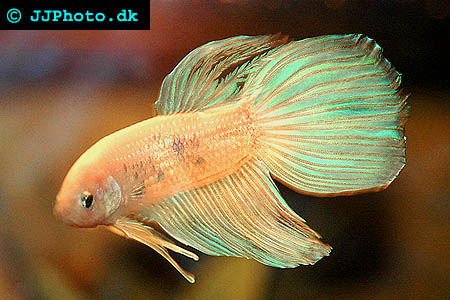
betta picture
A white betta male. Copyright www.jjphoto.dk
Since the male Betta is extremely territorial several males should not be kept together in the same aquarium. It is better to keep just one male Betta with several female Bettas; as long as you make sure that the female Bettas have a lot of good hiding spaces in the aquarium. The male Betta is not only aggressive towards other males; he will chase the female Bettas around as well and without suitable hiding places the female Bettas will become much stressed. You can of course keep only female Bettas to avoid this problem, or keep a male Betta with nothing but other species that won’t be harassed by him. Betta is often kept with Swordfish, Platy, Angelfish and small Gourami species.

You can feed your Betta meaty foods (fresh or frozen) or special Betta pellets. Your Betta might need a little help to understand that pellets are actually food. If your Betta refuses to eat pellets for a long time you should offer it other types of food, since Betta fish sometimes starve to death when they fail to understand that they are supposed to eat pellets. Your Betta will more readily accept meaty foods, including brine shrimp, tubificids, daphnia, blood worms and grindal worms. Feed your Betta twice a day or more. If you have other species in the aquarium you might need to lure them away to make sure that your Betta gets any food at all.

Betta Fish

Betta fish is one of several genera in the Family Osphronemidae. The most famous Betta is the Siamese Fighting fish (Betta splendens). The word Betta comes from a local Siamese name for Siamese Fighting fish, “Ikan Bettah”. The contemporary Thai name for this fish is Pla-kad. Since Bettas – especially the Betta splendens – are so popular among aquarists, we have given these fishes their own section here at AC Tropical fish. If you want to read about the other genera in the Family Osphronemidae, you will find a lot of useful information in the Gourami section of the articles library.


Siamese Fighting fish is not the only Betta fish that is well liked by aquarists. The Betta genus contains more than 50 described species. Most of them can be kept in aquariums but it is only a few species that are commonly kept by other aquarists than the true Betta enthusiasts. One of the most frequently kept Betta species aside from the Siamese Fighting fish is Betta imbellis – the Peaceful Betta. The Peaceful Betta is native to Malaysia and can reach a maximum size of 8 centimeters (3 inches). As the name suggests, it is a docile fish compared to the Siamese Fighting fish and the Peaceful Betta can do well in a community aquarium with other tranquil and non-aggressive species. The ideal water temperature is between 24-28ยบ C (75-82° F) and the pH should be kept in the 5.5-7.0 range. Wild Betta imbellis inhabit densely grown waters and you should therefore provide your Betta imbellis with plenty of hiding places by decorating the aquarium with lots of plants. A Betta imbellis without any hiding places will become extremely stressed.


In South East Asia Betta splendens is traditionally kept as a fighting fish. The Bettas kept in Asia as fighting fishes were brown with a tinge of green and their fins were much smaller than the fins that we can see on the aquarium kept Bettas of today. If you keep a Betta fish in order to make the fight other Bettas, you will naturally have no incitements to breed fancy Betta fish with long and flowing fins that can easily be injured. Betta fighting is still popular in many parts of Asia and those Bettas can look very different from the forms that we find in aquariums. Male Betta splendens are highly territorial, and when put together in the same container they will fight until one of them dies. In the wild, a weaker male can always choose to leave the territory before he becomes deadly injured, but this is naturally impossible in a small fish bowl or aquarium.

The Betta fish species were quite unknown among European and American scientists and fish enthusiasts until the early 19th century. The King of Siam at that time was allegedly a huge Betta fan and he loved to attend Betta fights. A doctor named Theodor Cantor was given a Siamese fighting fish, supposedly directly from the King of Siam, when the doctor was working in Siam. He became fascinated by the Betta fishes and studied their behavior for 10 years before he published an article about them. He called his fish Macropodus Pugnax. A few years after the turn of the century, another doctor developed a similar fascination for these interesting fishes. His name was Dr. Tate Regan and he changed the name Macropodus Pugnax to Betta Splendens.